Tuesday, August 12, 2008

Double boots, one more time.....

There is no story of a great feat or feet in this case. Just a caution and a a little jubilation of getting away unscathed, again. And another lesson. learned or relearned, taught by a hard, but incredibly beautiful mistress. No technical difficulties to over come or one arm pull ups involved. It happens every day, all year long, in Chamonix. For myself and my partners on this tripjust a small part of a bigger adventure this winter.


I was lucky enough to climb most of Feb, March and a tiny bit in April this year in Chamonix. That after starting the ice season earlier than ever in Nov. in Canada and then Montana and back to Canada again in Jan. And the season isn't done yet. Hopefully I'll get another month yet in Canada again before everything has fallen down.


In all that ice climbing I have used dbl boots once this winter in NA (Canada) and on fourclimbs in the Alps.

But more than once I have regretted my choice in footwear. Never while wearing dbl boots however.


No one dislikes climbing in dbl boots more than I do. They (any of the three best currently available) are big, and bulky and heavy in comparison to the single boots I am using. The up side to that is they offer more support for your calfs and feet and more protection from the pounding endurance alpine ice will give your toes. All that before you get to the added warmth they offer and the added benefits of a dbl boot drying out in a bivy.


Check out the climbers on the S. Face of the Midi.


And for perspective the little bump in the middle of the Massif which was our school room on several occasions. The Cosmic Arete is the sky line ridge, left to right. S. Face of the Midi is the clean wall on the right.


Duringlate Feb and early March in Chamonix my partners and I kept getting bounced between -20 temps or lowerand 20+ cm dumps of new snow up high. All that while trying to get acclimatized on the Midi at 12391 feet(3777 m).


Most every chance I got I would hop on the Midi tram and head to 12K feet or at least to 10K on the GM lift. For a flat lander coming straight from sea level there were some painful days in all that. And the GM had a better lunch :)


One of our first adventures was a little trip out the tunnel on the Midi in a wind storm after a 15 to 25cm dump of snow. The first lift on the tram was late as is typical after new snow but I was pressing to get some climbing in. At that point I was 7 days into a 44 day trip and not done any climbing yet. But the skiing was good :)


In crotch deep new snow (so much for the 15cm) before we even hit the end of the rope hand rail on the Midi arete Josh's noise was white withskin freezing up. It was cold and the wind was whipping. Hard to judge just how cold it would be at 12K from our apartment in town. (and that got only slightly easier in the next month) Josh was smart to turn around as his Rudolf's nosedeclared for the next week or so. He got revenge by coming back on a still and blue bird day for his solo climb as we road the lift down off the mtn.


Matt and I continud and ventured off to "look" at the Cosmic Arete. Two French parties were held up in the old worker's hut at teh basse of the ridge out of the wind. The sun felt good and Matt and I thought, "why not take a look". After all how hard could it be?


Mind you the last tram down is at 4:30 and we didn't even get off the tram till after noon...so the real question should have been, "just how fast are we?"


In good conditions the Cosmic Arete is a awesome alpine romp that generally takes an hr or so. We hit the Midi platform at 5:30 that afternoon. More to that story but not the point thsi time out.


-20C (around -5F) and a strong wind can be pretty cold. At 12K feet it is cold even in the sun if you are not acclimatized. By the time we got to the last 4 pitches of climbing I was full on shivering even in a MEC Tango belay jacket over a Atom LT and two hoodies. Thankfully my feet we not yet cold. I was wearing a pair of Scarpa Ultra single boots. But it was obvious to me that when my feet did get cold...and it was just a matter of time....I would be totally FOOKED. Quick way to end a climbing trip, that.


The good news was the last 4 pitches were excellent and funclimbing in most any conditions, even that particular day. And thankfully no more trail breaking in deep snow. My feet were out of the snow for the most part and my core was finally warming up again from the effort of easy technical climbing.


I made myself a promise after thatfirst climb...."always bring full face goggles and always wear my dbl boots up high here".


Of course I failed to keep that promise and regretted it every, single, time.


By the end of my trip it was early April. Things had warmed considerably up high aroundChamonix.

More storms were rolling through the mountains by the end as well. The power of a good storm in the Alps rivals anything I have seen in Alaska. Impressive. Scary if you have to be out in it.


There is a reason for all the huts in the Alps. Getting caught out in those conditions with out brick and mortar around you, canjust aseasily kill you. The final storm we weathered at the Cosmic Hut would have, if you had been unprotected onroute.


The obviously now happy campers leaving the upper tram terminal after being stuck on the Midi for two days..


When the final tally was made and the tram started down again on day three, half of the 20 passengers were French Mountain Police and Chamonix Guides. Bad weather can catch anyone, even the most experienced. I counted. There were 4 pairs of single boots in the crowd. I felt terribly under dressed. And happy I had a hut and WC to hid in for ourtime up high. Spantiks weren't a fashion statement there...but a survival tool.


It is all about conditions, isn't it :)

Who Makes Your Bottle Cage?

Bob Poor, King Cage, Interbike

So... do you know who makes your bottle cages? It might seem like a silly question. I mean, of all things, one is not about to seek out some super special artisanal cages, right? Well, recently I learned that mine were just that: made by Ron Andrews and crew, by hand, in Colorado. I feel a little embarrassed that I did not know this aboutKing Cage bottle cages, but the truth is I didn't. I bought mine because they were available at local bike shops, reasonably priced and reputed to be good. I like them, but I assumed that like most things they were mass produced in Taiwan. Until there I was, walking around Interbike. And there he was, a guy wearing a crown and twirling around all manner of cage-like contraptions. Several minutes into our conversation, it finally dawned on me that this person actually makes my bottle cages. I also learned of his connection to the Fat City Cycles clanand our local New England framebuilders. He asked me how this guy and that guy were doing. I get ridiculously excited by encounters like this.


King Cage at Interbike

Of course it's generally impossible to be at the King Cage booth and not get excited. It is like a miniature circus. A wind-up monkey dances across the table, inserting a tiny water bottle into a miniature cage instead of banging cymbals.


King Cage at Interbike

Items such as stop motion animation booklets and huge titanium back scratchers are demonstrated with enthusiasm.


King Cage at Interbike

An under-the-saddle titanium cage, with titanium flask sporting an #OCCUPYBIKESEATdecal. There was much more, and the booth was a bit like a parallel universe. Soon I craved every crazy accessory made by King Cage. But I limited myself to snagging a set of titanium cages at special Interbike prices, before they were all gone. My roadbike was very pleased to receive these!


King Cage at Interbike

Ron Andrews started out making cages in titanium, and still offers these in addition to the more popular and affordable stainless cages. He also offers titanium tire levers, stainless toe cages, and top cap mounts (pictured above) that make it possible to attach a bottle cage to a bicycle's stem. All of these items can be bought from the King Cage website directly, as well as at many bike shops.


King Cage at Interbike

Other than a Nitto cage I once received as a gift, all of my other bottle cages have been by King Cage. They are advertised as lightweight, non-marking and super strong, and after 3 years of use I have not experienced anything to contradict that. I use them with both plastic and (twine-wrapped) stainless steel bottles, and it's always a good fit. I can't fully explain why it made me so giddily happy to learn that these simple cages - widely available and relatively inexpensive - are made by hand by a friend of friends. Maybe it's precisely because they are such small accessories, and many of us don't give them much thought. It is heartening to know that somebody does, that somebody has made them their life's work with such dedication and panache.

Sunday, August 10, 2008

The Other Side of the Road


Back in Boston for a few days, I am in re-adjustment limbo - feeling tentative, not altogether present. Everything here is so familiar - the roads, the sounds, the smells, the people. And at the same time it all feels utterly strange, as if replaced with a hologram of the real thing. A muggy heat engulfs me when I exit the airport, giving the landscape that hazy, blurry, flickering look.


In this disoriented state, I decide to join my cycling club's Tuesday morning 100K ride. I need to feel more solid, planted, integrated into reality - and I realise this is the best way I know how. The thought irritates me. Since when did cycling turn into this? This... defining thing, this part of my chemical composition?


In the morning, logistics are irrelevant. I pull together a mismatched outfit from the hamper. I don't have my roadbike, so I grab the cyclocross bike that still lives at my house. And then I push off - on the right ("wrong!" my brain screams) side of the road, in morning commuter traffic. On autopilot, I weave my way to the Ride Studio Cafe and the miles between us disappear.


No one knows I am coming, not evenPamela. Reluctant to admit to myself that I miss her, I nonetheless watch the door in anticipation, until there she is - platinum braids thick as ropes,tanned slender limbs,Southern accent and all. She is duly surprised by my presence and we talk in bursts, in the way of friends who have not talked in some time. "You think I'll be okay on this bike?" I point to the fat all-terrain tires. Pamela waves it away nonchalantly, as if to say "Bikes! What do they matter. Let's go."


Of course everyone but me is on skinny tire racing bikes. The thought that this might be brutal drifts through my mind.The Tuesday rides are described as "social pace," but of course for me that means "best effort pace."My eyes are swollen from lack of sleep and my legs ache from the sum of all earlier rides. I realise that brutal might actually feel good right about now. Again, I am irritated at the thought. Now why would brutal feel good, what on earth is wrong with me?


It is obscenely hot and the turnout is low today. The 5 of us set off in a single file and stay that way for most of the ride. Remarkably, I am in the middle of the group, rather than struggling behind it. My legs turn the pedals as I play a little game I learned in Ireland, called "same cadence, bigger gear." It is a fun, but painful game. I have played it for 10, 20 miles at a time before. Today I would play it for 60.


We arrive in Harvard, MA, eat lunch, then climb to the Fruitlands. On top, we stop at the side of the road to take in the view of surrounding mountains. After Northern Ireland, this strikes me as funny, that there is a specific destination with "the view." Over there, the landscape is so open that the view is everywhere. As you're riding, you can see for miles and miles - undulating glens, the sea, the entire Sperrins mountain range, even the hills of Donegal across the water. By contrast New England is so woodsy that you seldom see beyond your immediate surroundings; it is as if you are riding through a tunnel the entire time. Psychologically this feels very different. Riding through forests turns me inward; riding through glens opens me up.


The descents here feel tame compared to what I've been doing in previous weeks. On the other hand, the condition of the roads is even worse than I remembered - enormous cracks, ridges, gaping ditch-sized holes in the crumpling pavement - stunning when you're not used to it. But the texture of the pavement itself is smoother. In Ireland, the tarmac is a sort of chipseal, its surface nearly as rough as gravel at times.


By the afternoon, the heat has reached its apex and we all feel it. We start to take breaks now. We groan, we pour water over our jerseys. I am drained, but also lulled into a pleasurable trance by the intense scent of pine trees in the heat - this is something I've missed.My legs are leaden and I am caked in salt, but I give it one last push, inspired by Scott's relentless pace. Scott is a strong rider, whose compact, muscular body looks like a purpose-built machine when he pedals. I focus on staying on his wheel. Even though I know he is controlling his speed for my sake, just being able to follow him like this feels unreasonably good. Then I push further still and lead for the last couple of miles.


Back at the club house I hear "Hey, you're back!" The familiar voices are as welcome as the blast of air conditioning that greets us. Suddenly shy from the attention and the disconcerting sense of ...what's the word I'm looking for, belonging? I mumble "Yes... Well no, I'm only here for a couple of days." But with my legs weighing me down, Pamela sipping iced coffee at the bar, and the jungle of bikes suspended from the ceiling, I do start tofeel more grounded, and Boston starts to feel realer.

Sunday, August 3, 2008

Political attention & during/after Mt Rainier's flood photos

Mt. Rainier is getting a lot of attention these days. On the political side of things, the new Director of the National Park Service, Mary Bomar, visited last week. She toured flood damaged areas firsthand and spoke with NPS personnel about the event, the progress and the longterm difficulties. And today, U.S. Representative Norm Dicks followed suit. The Congressman also visited many of the damaged areas, and like Mary, wanted to get a better sense of what it was going to take to get Mt Rainier National Park reopened.

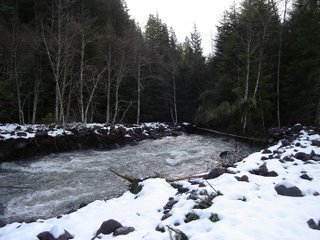
This flood/rain/storm event has made evident the challenges of managing facilities and roads in the shadow of a major glaciated peak that is slowly loosing its glaciers. Kautz Creek is quickly becoming the poster child of how Mt. Rainier National Park will manage this complex situation. As it stands now, Kautz Creek continues to flow over the Nisqually to Longmire road because it jumped its main channel upstream in an area that is legally designated "wilderness." The hard question is, how do you provide safe, reliable, and financially feasible road access through a threatened drainage that is known for glacial outbursts and episodic floods? The photo above displays the culprit, Kautz Creek, shortly before it enters unchartered forest as it forms a new channel. This picture was taken roughly one mile upstream from where the creek now intersects the main road.
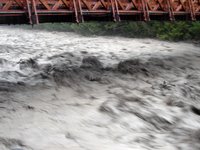
And speaking of photos... Here is another set of "during and after" pictures of Mt. Rainier's flooding. This set focuses on the Nisqually River bridge near Longmire, seen here on Nov. 6th.
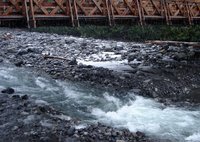


Compare this to roughly the same image today, an obvious contrast to the muddy storm flow above.

On the media side of things, the News Tribune digressed from the storm damage coverage to tell us how high Mt. Rainier is, EXACTLY! Who'd have guessed how complicated this answer was?

Thursday, July 31, 2008

Route updates and more incidents

There are a number of climbing conditions updates now that the mountaineering rangers are regularly patrolling the standard routes. The Gibraltar Ledges, Emmons, DC, and Kautz were all climbed last week and we still welcome your reports if you're out and about...

This weekend went by without a mountaineering "accident," but their were "incidents." The first one involved three climbers who separated while descending from high camp on the Kautz Glacier. Two climbers (the faster pair) took off hoping to wait (relax) in the parking lot for their buddy. Can you guess what happened next? After spending much of the day wondering where their "teammate" was, the climbers finally contacted the NPS hoping to initiate a search. Sparing you the details, the third climber eventually showed up on his own many hours later. During which, his buddies were sent out to retrace their descent. Free advice: if you set out as a team, stick together. This is especially the case on descents that involve glacier crossings and cloudy/whiteout type weather.

And once again, we had another team use a cell phone to call their emergency contact and 911 for information and directions. Thankfully, the climbers worked out the issue before the NPS had to dispatch a climbing ranger team. Really, be prepared to sit out bad weather (which is common) on Mount Rainier, or become fodder for this blog. ;)

And speaking of cell phones, I've been getting a few questions about the "preferred" cell phone provider on the mountain. Truth is, I don't know. I think that each service does better in some places and elevations than others. That said, I'd be curious to get your comments on where your cell phone has worked and where it didn't (we know they work well on Liberty Ridge BTW). If you've used one while climbing (it can
be fun to call a friend while on the mountain) send me your comments so that they can be shared with other climbers.

The last and most significant mountain "related" news involves a search for a missing day-hiker on Eagle Peak. A 47 year old man didn't return from his hike last Saturday. I suspect that there will be more information released on this issue if things don't get resolved soon, stay tuned.

And if you're wondering, the opening photo is from the now famous Camp Schurman toilet seat. Dmitry Shapovalov's wanted to share the view with all of you. But if you head up there today, don't expect to see this unless you leave the NEW door open! Let's hope that this one makes it through the summer.

Sunday, July 27, 2008

Great day in the woods


After shooting this morning's sunrise on Lake Superior I spent most of the remainder of the day exploring a remote section of Hollow Rock Creek. Hollow Rock Creek has a couple of really cool waterfall areas that are difficult to get to... no trails lead to these areas, so you have to bush-whack your way in and believe me, the going is pretty rough!


Once you get to the waterfall areas, however, the effort is well worth it. The beauty of Hollow Rock Creek is not an "in your face" kind of beauty... its beauty on a smaller scale. You have to look closely to see it, but once you start to look you soon find yourself seeing things you would have otherwise missed. The weather was perfect for this day of exploration along Hollow Rock Creek: overcast skies with very thick cloud cover. The cloud cover makes for a very even, muted sort of light that is conducive to shooting under the forest canopy. Bright sunny days are less desirable when shooting in the deep woods as the rays of sunlight create areas of extreme contrast that are almost impossible to expose correctly in a photographic image.


(Above: "Trapped" - A leaf that was stuck on the bottom of the creek)

Also, once most of the leaves have fallen off the trees, that doesn't mean that you should put your camera away and stop venturing out into the woods. It simply means that you should try looking other places to find your images... namely, along the ground! Its one of life's great pleasures to wander along a little creek like Hollow Rock and look for all these neat little things that catch your eye.


(Above and below: Swirling leaves and foam)


(Below left: Pothole along Hollow Rock Creek)